Thursday, July 30, 2015

Diary of a Madman (Ozzy Osbourne, 1981)


This album, along with Blizzard of Ozz (1980), comprise the Randy Rhoads era and are probably the best albums in the Ozzy Osbourne catalog, though both were impacted by controversy when remastered in 2002. The problem was they weren't so much remastered as rerecorded. The original bass and drums, played by the respectable musicians Bob Daisley and Lee Kerslake respectively, were erased and rerecorded with members of Ozzy's current band. Rhoads and Osbourne were left as is. Even more confusing were the original credits of bass, drums, and keyboards to Rudy Sarzo, Tommy Aldridge, and Don Airey, none of who played on the album. Once again, the problem goes back to the root of Daisley and Kerslake's never-ending battle with reality TV star Sharon Osbourne, who in 1981 was happy to de-credit them from the album (Sarzo and Aldridge did in fact join the band, but not until the tour; Don Airey left the band earlier and the keyboard duties went to a guy named Johnny Cook), and then she completely obliterated them in 2002. I'm still not 100% sure which version of Diary of a Madman I am actually listening to, so I just tell myself it's the original and don't give a single thought to Bordin and Trujillo's involvement. If anyone can find something that provides a direct comparison, I would be very appreciative. I've listened to a vinyl rip and the opening drums of "Over the Mountain" sound identical to what I have, so I'm assuming this is the Daisley/Kerslake original. Either that or the replacement rhythm section really outdid themselves on playing exactly the same, which goes back to the original question: "Why did she do it?"

Let us leave this unhappy controversy behind us. All in all, Diary of a Madman is a solid album, and it kills me to say that, probably thanks to better marketing and publicity, it has the edge over what Ozzy's old band was up to around this time. "Over the Mountain" and the title track, which bookend the tracklist, are undeniable classics. Even the second tier material like "Flying High Again" and "Believer" is quite strong, and I can forgive the sappier stuff like "Little Dolls" and "Tonight". Even though "S.A.T.O" is Sharon's initials, it's a frantic little number that is almost a re-imagining of the old Sabbath song "Spiral Architect". Although I don't really associate keyboards with metal, they punch in at just the right spots, highly synthetic yet appropriate for the music is supports. In fact, I'm a little bummed that it isn't Don Airey playing because that guy has some serious hard rock credentials. He was a part of the "Great British Metal Shuffle of 1979", which saw Ozzy go solo, Dio join Sabbath, and Don Airey switch from supporting Sabbath on Never Say Die to being a full member of Rainbow. In fact, his Rainbow duties around this time are what kept him from assisting on this album, although he found the time to contribute to the previous album.

As indicated, the musician lineup playing on this album was effectively DOA upon the release of the album. Lee Kerslake was fired and never returned, electing to rejoin his old band, Uriah Heep. Although also fired, Bob Daisley, for a guy that seems to cause the Osbournes (mostly you-know-who) so much agony, would contribute to most of Ozzy's albums through 1991's No More Tears. The reason? The little public secret that Ozzy couldn't write an album's worth of lyrics to save his life. The fate of Randy Rhoads, of course, is no secret, and his ghost still lingers over every subsequent Ozzy album. I'm hardly an Ozzy fanatic, in case you haven't learned that yet, so I can't really offer much insight on the later albums. Some are good, others not so much. His career has never been on a steady trajectory in either direction. No doubt his inability to kick the rock star lifestyle at an "advanced" age, as documented in the film God Bless Ozzy Osbourne as well as accounts of the recording of the Black Sabbath album 13, are primarily responsible for this.


Tuesday, July 21, 2015

Wingspan: History (Paul McCartney/Wings, 2001)


I'm just going to come right out and say that nobody really needs to invest in either disc of Wingspan, neither the Hits, nor the History. It's not a bad collection of songs, but it doesn't break any new ground in the Paul McCartney catalog unless you count the throwaway "Bip Bop/Hey Diddle", an inferior lo-fi acoustic medley of two adequate album tracks. Then there's the "playout mix" of "No More Lonely Nights", which is completely unnecessary unless you are abnormally fascinated with the original song.

So what the heck was the Wingspan project? If memory serves me right, it was a "songtrack" for a half-baked documentary on the years from the first McCartney solo album to around the mid-1980's. I originally thought it was highlights from the period between McCartney and McCartney II and the ten-or-so albums in-between, credited variously to "Paul & Linda McCartney", "Paul McCartney & Wings", and even just "Wings" (which is why Apple created the "Album Artist" field so it doesn't wreak havoc with your iPod). However there is some spillover into the "Macca" years with Columbia, so there's no way to neatly describe the scope. It's a interesting period for Paul, who went from Beatle exile to submerging himself in another band identity, but then re-asserting his fame and eventually inflating into a commercial juggernaut. Although it's easy to call the earlier music more earnest than the later stuff, I always find something likable in every McCartney song, even the most gushy AM-radio grade stuff.

Probably due to lack of patience, I broke the set into its two main parts, so here we focus on the History disc (the second one). With a name as big as McCartney, even the "deep tracks" are fairly familiar to most people, though these are certainly not the A-listers. For example, tracks from Band On the Run for Hits would be stuff like "Jet" and the title track, while this disc takes on "Let Me Roll It", "Helen Wheels", and "Bluebird". McCartney, probably by virtue of being a pretty "raw document" in itself, gets 5 tracks, more than any other album, though "The Lovely Linda" is a puff piece and "Maybe I'm Amazed" really deserves to be with the Hits disc. Ram (co-credited to Linda) comes in with three tracks (four if you count the "Bip Bop" medley), making the pre-Wings era very well represented here. Nine of the tracks are Wings era proper, which can mean a lot of things, as the lineup was fairly fluid, but rest assured you get your Denny Laine fix no matter what album. The lackluster Red Rose Speedway and the most hits-heavy Wings at the Speed of Sound are not represented, but otherwise it's a pretty even spread. Finally, the "new" solo era gets a tiny bit of love, with four tracks over three albums, though I'm reluctantly counting the "No More Lonely Nights" remix as a part of Give My Regards to Broad Street.

Basically if you invest in McCartney, Ram, and Band on the Run, you aren't missing anything major here, though I have a soft spot for "Rockestra". Those three albums give you half the tracks here right away. Also, many of the tracks are in their "single edit" form, so listeners may find songs like "Rock Show" a little too truncated for their tastes.


Thursday, July 16, 2015

Speak No Evil (Wayne Shorter, 1964)


Jazz has taken a (completely random!) vacation from the blog, so dialing up Wayne Shorter proved to be a nice change of pace this week. Although this is the only album of his I have with his name at the top, I've been combing through the archives to familiarize myself with his other work.

Outside this album, most of what I've known about Shorter is that he was in the second great Miles Davis Quintet and some related Davis album, and was a founding member of Weather Report. In my recent attempt to scoop up the greatest 100 or so jazz albums, Speak No Evil, probably Shorter's best-known work as a leader, joined my collective.

This album was recorded right around the time Shorter joined the Davis quintet and along for the ride are his quintet friends Herbie Hancock and Ron Carter. Since Miles wasn't doing a lot of sideman gigs in the 1960's, Freddie Hubbard joins here on trumpet, while Elvin Jones handles drums (on loan from Trane, I suppose). Tony Williams was probably having too much fun messing around with weirdos like Dolphy and Andrew Hill to make an appearance.

As for the music, far be it from me to play the role of super-critic, but it's a little bit on the frosty side. Musically, it is far removed from Shorter's hard bop beginnings, but doesn't really give any indication of where Shorter would ultimately be in just a few short years. While there is a fair measure of freedom in the solos, it's within a pretty tight structure, with all of the pieces sporting clear beginnings and endings, hardly free jazz territory of later work. Maybe it's just the titles, but they seem to be drawn from nightmares: "Dance Cadaverous" and "Witch Hunt" in particular.

As is the case with all of the quintet members except Carter (who had no albums of his own during this period), the album was released on Blue Note. Lately I've found it interesting how a smaller, more "pure" jazz label handle the sidemen projects, while Davis was comfortably with the larger, yet not as jazz-inclined Columbia.

Fun fact: Until 2004, this album enjoyed the rare distinction of sporting all still-living musicians. RIP Elvin Jones and Freddie Hubbard!

Tuesday, July 14, 2015

Taken at the Flood (Robin Waterfield, 2014)

This is another entry in the excellent Ancient Warfare and Civilizations series from Oxford. This is Waterfield's second book for the series, following up on 2011's inaugural volume, Dividing the Spoils. Maybe I just wasn't paying attention before, but he is now listed as a co-editor of the series, currently at six volumes (all different authors). Here's to many more!

As for this particular book, it covers a period of time that frequently gets overshadowed by the Punic Wars on one side and the end of the Roman Republic on the other (and don't worry, this series has got those covered - stay tuned!). Working largely from the narratives of Livy and Polybius, Waterfield walks readers through the Roman conquest of Greece from the end of the third century BC(E) to the mid-second century. The Romans went from hesitant interlopers to crushing conquerors in a breathtakingly short period of time. Just like in much of Greek history, almost no player was a constant friend or enemy of Rome in a world a rapidly shifting alliances. It is probably the most dynamic period of Roman history, when a mid-sized Italian republic transformed into a Mediterranean superpower, knocking out virtually all of the Hellenistic successor kingdoms save Egypt in less than a century. Oh, and that whole Carthage thing got resolved as well.

Waterfield's view of Roman power isn't shared by everyone. In the introduction he open identifies with the belief that Rome's success was built by its culture of extreme violence. This violence, which fueled its armies, was completely overpowering to a Greek world unused to the concept of total war. Waterfield hints that this violence, which stoked military prowess and rampant conquest, would ultimately overpower the sadly insufficient mechanisms of government that drove the Roman Republic. However, the figures that would bring about the demise of the Republic has not yet burst on to the scene (Marius was just a child at the sacking of Corinth and Sulla not yet born), but their role models, men like Flamininus, the Scipios, and Mummius, were very much driving forces in these events. You'll be hearing a lot more about the imperial transitioning of Rome in future book posts here.

Monday, July 13, 2015

Christ Actually (James Carroll, 2014)

Between Zealot, How Jesus Became God, and now Christ Actually, I'm not sure I initially intended to read so much on the same topic over the past year. Each author, however, has a different background. Reza Aslan is a ex-evangelical Christian and current Muslim, Bart Ehrman is an ex-evangelical Christian and current agnostic and New Testament scholar, and James Carroll is an ex-Roman Catholic priest and current reform-minded Catholic. The lives of each of these three men had an impact on the tone and focus of each book.

Carroll has ruffled more than a few feathers in the past with his book Constantine's Sword, which shows the intimate relationship of anti-Semitism and the Catholic Church. In many ways, this book is a continuation of that discussion. Mid-twentieth century atrocities (Hiroshima, the Holocaust) that ushered in the "Secular Age" have forced Christianity to come to grips with its troubled history with Judaism. Carroll identifies the breaking point between Church and Synagogue as the Jewish Wars, a serious of Roman-Jewish conflicts in the first two centuries (AD/BCE - depending on how you roll). The Gospels were written during this cataclysmic backdrop of war and genocide and each Gospel is flavored by the events of the time. Carroll puts particular focus on Mark, which sometimes gets buried alongside Matthew and Luke under the cover of "synoptic". Carroll shows the far more apocalyptic tone of Mark compared to the others, and, as the earliest of the four Gospels, its closeness to Jesus as a Jew. Mark was also written nearly at the same time of the destruction of the second Temple, and surely this was on the Gospel author's mind. Out of a survival instinct the early Christians (the "Jesus People") distanced themselves from the other Jews and fell into the orbit of Rome.

There's a lot of strong medicine in this book and it's probably not the most comfortable read for those not ready to face the uncompromising nastiness of war. When we read "the city was sacked" in a history textbook, it is an antiseptic line covering up all the atrocities of rape, murder, and destruction. We nearly take for granted now that soldiers draw a salary, but back in the day plunder was their compensation, a devastating and humiliating punishment for the losers. However, for those concerned about how Christianity can continue in the present day, especially in the face of an overwhelmingly secular society, this makes for stimulating reading.

Thursday, July 9, 2015

Counterpoints (Argent, 1975)


Looking back on some previous posts, I realize I've covered the Argent catalog quite well up to this point. After this post, all that will remain is the second album, Ring of Hands, and the second-to-last one, Circus. There's also the live album, Encore. Of the three, I only have the first one, so the Argent era of this blog may be drawing to an end soon!

So....Counterpoints. Well, until relatively recently, I wasn't even aware that the band had released two albums following the departure of Russ Ballard, this one and Circus, both from 1975. Losing a band member responsible for writing half of the material on paper should have been a killing blow to the band, but then again the band is called Argent, not Ballard, so it really isn't a huge surprise that the band continued with two new members, John Verity (guitar/vocals) and John Grimaldi (guitar). Another major change, more behind the scenes, was the end of Rod Argent's writing partnership with Chris White, his old Zombie bandmate. I'm not sure if anything negative caused that, but White was becoming more involved with A&R stuff rather than songwriting anyway. On Circus, Rod handles all of the writing except for one track penned by bassist Jim Rodford. Counterpoints is similarly written, but Grimaldi gets a couple songs of his own into the mix.

Since Rodford and Argent shared vocal duties with Ballard on almost all of the previous albums, the vocals on Counterpoints are not drastically different from the "classic" era. Verity, most prominent on the opener, "On My Feet Again", "Time" and "Rock and Roll Show" actually sounds Ballard-esque. Musically, some of it isn't a big departure from albums past, but Grimaldi's "It's Fallen Off" (great title?), the bridge of "Time", and "I Can't Remember But Yes" feature some crazy Mahavishnu Orchestra-grade jazz fusion style, showing that the band pushing past simple prog territory. I have no doubt the new members fueled this development, particularly Grimaldi, who, unlike Ballard, could focus entirely on guitar and let the others handle the singing. There are also some quasi-confirmed rumors that drummer Bob Henrit played very little or nothing on this album due to illness, forcing the band to borrow some guy from Genesis to...ahem...hold down the beat.

Finally, there's the little matter of the availability of this album. For some reason, Circus received a proper CD release as a two-fer with some earlier album (I can't remember which, but it was probably one of the first two), but Counterpoints did not. Furthermore, Circus is readily available as download, whereas Counterpoints is not. Thankfully, some kind people have been uploading various tracks to a popular video streaming website and it isn't too hard to make clever use of various extensions to build your own album. However the quality is typically pretty wretched and I'm sure some of what I found is missing small parts here and there. But, if you're not an OCD audiophile and you just want to hear the final Argent album, there are ways to achieve this. Songs come and go, but the one "must hear" track is Rodford's "Time". In general, the songs on the first half of the album are better, though "Butterfly" is also an excellent track, making good use of either trumpet or trumpet-sounding keyboard.

If you really want a challenge, try finding yourself a full copy of Rod Argent's solo debut, Moving Home, released three years later.

Tuesday, June 30, 2015

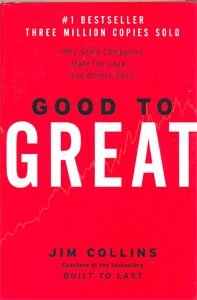
Good to Great (Jim Collins, 2001)

Back in my retail days, when I was impervious to long hours and low pay, Good to Great was one of a number of business titles I read in my quest for superior inventory management techniques. As I wrapped up grad school and got out of management, I lost interest in reading them and at times I felt outright hostile to Good to Great. After all a book that extols the virtues of Fannie Mae (corruption) and Circuit City (bankruptcy) must have missed the mark.

Much to my surprise as I returned to a leadership role in my career, I found that people still recommended this book. So, with a measure of trepidation, I returned to Jim Collins's masterwork. I have to say, although it takes some brain power to disassociate a number of distasteful events that affected the "good-to-great" companies, the principles distilled from his thorough research still resonate strongly. Overall, the trick is to work from the inside out, starting with "Level 5 leadership", then getting the right people on board, before working on the one great concept you're passionate about and can be the best at (the "hedgehog concept").

I've been long aware that this book is a "prequel" of sorts to Collins's earlier book Built to Last. He connects concepts between the two books at the end and I think I'll need to go back and read that one to fully grasp some of the points. Also, I think some brain power will be necessary to translate the stories of successful publicly-traded for-profit companies to a library environment. It's not easy, but I know the connections are there.

As an amusing aside, the touting of "hedgehog" puts Collins in direct contrast with an earlier book I read this year, The Signal and the Noise by Nate Silver. In that book, Silver advocates for the "fox" instead. However, he was advising this for aspiring political pundits, not business leaders, so take that whichever way you like!

Sunday, June 28, 2015

Sabotage (Black Sabbath, 1975)


Reviewing some of the past Black Sabbath posts here, it looks like I've already tipped by hand regarding my thoughts on Sabotage, so I'll try not to be too repetitive. Although it is typically regarded by Ozzy purists as the last "great" album by the band, it's probably better to describe the album as a gateway of what was to come from the band.

Sabotage retains a number of musical elements that were expressed to their fullest on 1973's Sabbath Bloody Sabbath, particularly in emphasizing riffs over solos. On the other hand, the band was now on the other side of a rather introverted period for the band with very little activity beyond their appearance at the 1974 California Jam (oddly notable for showing Iommi minus the mustache). They were beat down pretty hard during this time, mostly in the legal department. At the same time, they were continuing to seek a somewhat new musical identity and it pops up in places here.

The red meat for the purists here are "Hole in the Sky", "Megalomania", and the first chunk of "Symptom of the Universe". In fact I remember walking back into the stockroom during my bookstore days and hearing "Symptom" going full-bore and the employee just standing there having his mind blown. No doubt it's a really hard charging song, but overall not the direction the band was heading. The evidence is in the second part, introduced in the studio, softer and acoustic and everything the first part wasn't. Lest anyone doubt this part appeared later, witness the live version (originally from Live at Last, then made official on Past Lives) that abruptly ends after the first part.

Moments like this, along with instrumental bits like the acoustic "Don't Start (Too Late)" and the choral workout "Supertzar" show this is a band not intent on revisiting the old days of Paranoid. The synthesizers are ramped up as well, particularly on the album's second side in songs like "The Thrill of It All" and the overtly commercial "Am I Going Insane (Radio)". To be clear, the latter is not a "radio edit", but instead the greatest case of a British band messing with their American fans since Zeppelin's "D'yer Mak'er", as "Radio" is rhyming slang for crazy (crazy=mental=radio rental). Finally, "The Writ", a rare song that features lyrics by Ozzy (Geezer was the usual lyricist for the band and I can only guess putting Ozzy in the credits was an act of generosity), brings everything together, a heavy, solo-less mini-epic polemic on the band's legal woes. Depending on your version of the album, the fadeout of the monster riff brings things to a close, or a little ditty by Ozzy and Bill Ward called "Blow on a Jug" appears after the fade, a rare moment of sheer whimsy on a Sabbath album.

For the continuing saga of Sabbath, you can continue on to Technical Ecstasy. If you like to read about bands going off the rails, it makes for some gripping reading!

Saturday, June 27, 2015

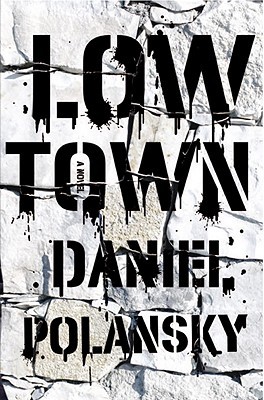
Low Town (Daniel Polansky, 2011)

It's surprising that nobody has thought of putting a classic noir story in a fantasy setting. Or maybe somebody already did and I just never heard about it until now.

Low Town (British title: The Straight Razor Cure) is a smart mashup of the two genres. As many other readers have noted, it's not a stretch to completely lift the main story out of its fantasy setting and into the worlds of Dashiel Hammett or Raymond Chandler. In fact, this is the main liability of the novel: the fantasy world at times doesn't hold up particularly well. In particular, a visit to a corrupt noble's home feels like the Warden (our nameless hero) walked into a mid-20th century estate in the nice part of town.

Although Daniel Polansky is an American author, he seems to have lost his
American publisher. Therefore, the remaining two books in the series are UK-only titles, and his new series (a duology, I think) is also not available in the United States. But, it's a small world after all, so I'm sure this won't prove an overly cumbersome barrier to being able to read these books sometime down the road.

Friday, June 26, 2015

Ellen Foster (Kaye Gibbons, 1987)

With the exception of The Joy Luck Club (1989), Ellen Foster is the latest chronologically published book to date in the Novels for Students series. For reference, there are 49 volumes in the series and this is the third, published nearly 20 years ago. With a little quick math, one learns this book was only ten years old when included in the series. We've already tread here with Democracy, but it's clear the compilers of the series were not identifying "classics" in the strictest sense of the term, but also trying to identify "current literature" that may have been entering the classroom at that time. Some, like The Giver (1993) enter proudly into the classics column at a young age. Others sort of just run their course.

While I'm not sure Ellen Foster has held up as well as some of its contemporaries, it enjoyed the fruits of the "Oprah effect" when it was picked for the book club in 1997 along with Gibbons's second book, A Virtuous Woman. Over time it's been buried heavily by subsequent more prominent and/or controversial selections. It would be easy for me to dismiss this as Oprah fodder (female main character, serious family problems, frank discussion of race), but I'll try to take the high road here. Like most of Gibbons's books, it's very short. Having not read any of the other books, I can't say any comparative about the structure, but this book is a kind of micro-Odyssey as Ellen, the eponymous 11 year old protagonist of the book, flees from her abusive father and seeks a surrogate parent. Either due to outside circumstances (friend's family, teacher), or internal conflict (aunt, grandma), nobody really fits the role to Ellen's expectations. There's a little bit of deus ex machina in the conclusion, but the structure of the book, going back and forth in time, ensures it is no surprise what will eventually work for Ellen.

As I was fully aware going into reading some of these books in the series, I'm likely not the target audience of this book. However, I tried approaching it with an open mind and found there was plenty interesting about the book. While I'm not going to rush out and complete my Kaye Gibbons bibliography, I'm glad I read this book.

Thursday, June 25, 2015

The Beta Band (1999)


The Beta Band's first proper album was hailed as "the worst album of the year" and "f&*#ing awful" (this is a family blog) by the band itself. Granted, the album is a mess, but it's a beautiful mess. It's safe to say that the band resides in the weirder realms of my music collection, but, both before and after this album, the band was constantly doing fine-tuning along the spectrum.

The previous year, the band garnered a good deal of attention by combining their first three EP's into a single album, cleverly called The Three EP's. While many are inclined to just accept it as their de facto first album, it's actually better appreciated by its component EP's. Champion Versions (1997) and Los Amigos del Beta Bandidos (1998) were fairly "normal" outings, while The Patty Patty Sound (1998), released between the two, is, by all measures, a strange one. It's almost as if the band is "reacting" to its preceding recording. I'll save a detailed analysis of the early years for whenever I finally dial up The Three EP's for the blog. For now, I'll posit that the self-titled album was reacting to the tameness of their third EP.

From the opening track of this album, you know it's going to be a wild ride. "The Beta Band Rap" is a triptych of "Mr. Sandman", hip-hop, and rockabilly that somehow manages to tell the story of the band up to this point. Although I've heard this song many times, I'm still incapable of relating the story back. Maybe some OCD-afflicted soul has transcribed this to a lyrics site somewhere. "It's Not Too Beautiful" is the second track and the standout of the ten. Hate on this album as they do, I was pleased to see it remained in their live show through the rest of the band's lifespan. Sampling John Barry's score to "The Black Hole"? Genius. "Simple Boy" is a short and unremarkable song except for the fact the bass put my car's Bose speakers to the test. "Around the Bend", if I call correctly, was the most promoted track of the album, though I can't say if it was a proper single. Like the best parts of The Three EP's, it has a more acoustic feel, with trademark rambly lyrics thrown in for good measure. "Dance O'Er the Border" continues what the previous song started in the lyrics department, a maybe-not-intentional stream of consciousness approach, but now set to a thumping dance floor beat. Jangly guitars return for "Brokenupadingdong", later overtaken by some impressive percussion work, presumably by Robin Jones, all of which worked like a cup of strong coffee on my morning drive.

Up to this point I don't think I'd be out of line to call the band's criticism of the album out of line. However, the last four tracks show signs of fatigue. "Number 15" just isn't that exciting a song and "Smiling" is about 6 minutes longer than it needs to be. For close observers, though, it is a relative to "Monolith" from The Patty Patty Sound (where "Dry the Rain" was the past, "Smiling" was the future, though listeners in 1998 didn't know it yet!). About the best thing I can say about "The Hard One" is that I still love how they mess up the lyrics to "Total Eclipse of the Heart" such that now the singer is always falling in love. In fact, I think I like that better. The downside is that 10 minutes of this is a bit wearing. Finally, "The Cow's Wrong"? I still have no idea what's going on here, but it's the only appearance of Gordon Anderson in the credits of the album.

Aside from Robert Christgau (the embodiment of everything wrong with music criticism), most people will rank this album lower than The Three EP's. It's understandable, keeping in mind that album routinely appears on 1990's best-album lists. However, with the gift of hindsight, we know that a more "synthetic" future lay ahead for the band. Also, everything was tightened up considerably for the next album, Hot Shots II, most likely in reaction to this album. While technically a more coherent effort, much of the charm present on this album was absent from that one, an (in yet another reaction!) only partly restored on their final album.


Tuesday, June 16, 2015

Nonzero (Robert Wright, 2000)

Nonzero has been on my to-read list for quite some time. In fact, it's been so long since I added it to the list that I can't even remember how it got on my radar. It turns out that a lot of the stuff I added back around 2011 and 2012 came from referrals from David Brin's blog, Contrary Brin. I haven't read the blog in quite some time, mainly because it seemed to be getting a little too crackpot in places and too verbose in general, though I generally think he makes a lot of sense (on a side note here, I'm saddened that Brin can write a torrent on his blog, but only deliver two novels in the 21st century).

Fast forward to 2015 and Nonzero has percolated its way of the list to the top of the queue. In this book, Robert Wright, author of The Moral Animal, explores the idea that both biological and cultural evolution advance toward some kind of purpose. That purpose is advanced through the notion of "nonzero-sumness", a game theory concept that we advance as a species through "win-win" outcomes. In other words, one entity's success need not be the result of another's failure. He is quick to distance himself from the old-school cultural evolutionists of the 19th century that used the notion to fuel racist and imperialist agendas, but he is clearly against the more recently popular notion that every culture is special in its own way and one society is not necessarily more advanced than another. Indeed, it's a bit of a tightrope-walk, but in his overview of human and biological history he demonstrates how both have "advanced" - indeed, improved, over time, through zero-sum "games". It's an interesting hypothesis, that I think many will initially disagree with, though it's hard to find fault with Wright's reasoning.

Maybe I'll need to get back to reading Contrary Brin to see if I can find some more book recommendations. It's not like I don't have enough to read as it is!

Monday, June 15, 2015

StressFest (Steve Morse Band, 1996)


In spite of his impressive work with Kansas (in the 1980's) and Deep Purple (from the 1990's onward), not to mention his own bands, the Dixie Dregs and eponymous band, Steve Morse remains a largely unknown guitarist outside the community of musicians. Musically active since the 1970's, Morse generally stuck to instrumental rock, a genre that was of niche interest at best since the mid-1960's. Even attempts to add vocals from hired guns like Alex Ligertwood and Patrick Simmons did not propel him into the mainstream. He probably had his best first crack at something larger when he joined the reborn Kansas in 1986 for two albums: Power and In the Spirit of Things. But even that career move wasn't going to be a definitive breakthrough as that Kansas bore little resemblance to its Kerry Livgren-era counterpart. It was no surprise that Morse returned to instrumental work with a tighter trio-configured version of the Steve Morse Band, which advances the story to around 1994.

At the end of 1993, the seemingly unrelated legendary British hard rock band Deep Purple was dealt what for most bands should have been a death blow. The second departure of Ritchie Blackmore was designed to kill off the band once and for all. One need not look any further back for proof than the first time he quit, with the band folding less than a year later. American replacement Tommy Bolin, in spite of his impressive chops on the guitar, was never accepted by the fans back then. It seemed like history would repeat itself when the band initially drafted Joe Satriani for a few shows, followed by less contract-bound Steve Morse on a more permanent basis. Neither choice was exactly what you would call inside ball and I'm pretty sure nobody in Purple had ever played with Morse prior to meeting.

Thankfully, the Morse decision paid off handsomely and he has been with the band for over 20 years, unseating Blackmore as the longest-serving guitarist of the band. However, Morse (and indeed most member of latter-era Deep Purple) maintained his side projects, including the Steve Morse Band in its regular formation of Dave LaRue on bass and Van Romaine on drums. StressFest, the first album released by SMB during Morse's Purple tenure, would invariably introduce his solo work to a whole new audience. Most of the attention that year was on his Purple debut, Purpendicular, so I'm guessing the album was probably done on the fly, following up a series of albums going back to 1991's Southern Steel. It pretty much follows the same formula as these albums, a trio approach where each instrument holds down around 33.3% of the sound. Well, maybe more like 45-30-30 in Morse's favor, and yes I'm doing the math correctly because these guys always give at least 105% effort. While it's great that the SMB has the confidence to keep doing what they always have, it is a little weird that in spite of over a year together, there is very little here that sounds even remotely like Deep Purple. I should amend this somewhat; they covered "Speed King", which was sadly relegated to Japanese bonus track status and didn't even make it into the later pair of Major Impacts cover albums.

Overall, like its three predecessors, StressFest is a listener's album and a musician's album. Although it chugs and rocks along in many places, one can't really appreciate it as background music. Many of the songs are subtle variations along a theme, so if you aren't paying close attention you can be forgiven for thinking the songs sound a lot alike. Around 10 years ago, I saw Steve Morse in concert, with the Dixie Dregs opening. Yes, Steve Morse opened for himself. How often do you see that happen? Anyway, near the end of the set, SMB busted through the title track and the slower and deeper "Eyes of a Child". Both were rendered excellently and received very well by the Coach House audience in San Juan Capistrano, which leads me to believe that this album still holds a very important place in the hearts of both Morse and his fans.


Monday, June 8, 2015

Meddle (Pink Floyd, 1971)


Except for Syd Barrett purists (see A Very Irregular Head), the "classic" era of Pink Floyd began with the 1971 release of Meddle. By this time, pretty much all of the Barrett influence had been scrubbed from the music and Roger Waters was asserting a greater leadership role, sharing or having sole credit on every song, as well as writing all the lyrics. It's the first album to use a genuine segue, with the howling wind of "One of These Days" whooshing listeners into the first notes of "Pillow of Winds". Of course, the real champion track is the side-long "Echoes". Normally, sidelongs are a Bad Idea, with Love's "Revelation" being probably the worst offender. "Echoes", however, is a multi-stage sonic journey, one that seems to get its sections just right, moving along before things get too dull. Even the "rock" section could probably pass for chillout if you are open-minded enough to accept music other than Enya. Being pre-Dark Side, though, there is still a little weirdness. For instance, pretty much everyone considers "Seamus" to be not much more than a failed experiment in having a dog serve as co-lead vocalist. "San Tropez", the only vocal outing by Waters, is the latest iteration in the Waters songbook of shuffle-type songs that had evolved along the lines of "Biding My Time" and "Free Four" and would ultimately reach fruition on "Money" a couple years later.

While Meddle is overall a fairly "stable" recording for Pink Floyd, the album is bookended by two shakier albums. Atom Heart Mother precedes, and is a more haphazardly recorded experience. While one may criticize Waters's skill as a musician, his architecturally-inspired management was a welcome addition (albeit in later years rather draconian). Meanwhile, Obscured By Clouds, which followed, represented the final soundtrack-contract work by the band and feels more like a throwback to the days of old rather than the album that would directly precede the following year's Dark Side of the Moon.

On a final random (and frankly mathematical) note, I picked up this album on CD in 1993, one of my first ventures outside of Wall/Dark Side territory. It's a little sobering to think my CD is now as old as the original album was back when I got the CD. And I thought 1971 was thousands of years ago back then!

Monday, June 1, 2015

A Very Irregular Head (Rob Chapman, 2010)

There is something about reading books by music journalists that is inherently unsatisfying. I think it has a tendency to be too opinionated in all of the wrong ways. More on that later. First, an overview of the very thorough Syd Barrett biography, A Very Irregular Head.

As a Pink Floyd-listening teen, I'd argue with my friends about who "was" Pink Floyd and the battle lines were drawn between David Gilmour and Roger Waters. By the way, the technically correct answer is neither; only Nick Mason appears on every Pink Floyd album. Of course we'd snicker at the random few people who contended that Syd Barrett was the real Pink Floyd and that every album since A Saucerful of Secrets was a fraud. We'd also get a good laugh at the concept of Syd Barrett himself. I mean the guy was totally nutters, right? There were all kinds of crazy stories of the "founder" of Pink Floyd doing freaky stuff, probably under the influence of LSD. Heck there was even Syd's First Trip (a questionable video account of his first time dropping acid), just to prove it!

Well, Mr. Chapman is one of those crazy Syd-defenders and he would have been absolutely appalled at how we gobbled up all of the stories. In 400 pages, he takes on the daunting task of disproving these stories and, in turn, painting a portrait of the real Syd Barrett, a genius with a fragile mind, not a simple "acid casualty". Now, 400 pages is a lot of material to write about a man with an extremely short recording history who destroyed virtually all of his primary source documentation. Chapman himself was not exactly a contemporary, having met Barrett only once, during the ill-fated Stars era and de facto end of his career. Therefore the book relies heavily on extensive interviews of his friends, though (aside from a few public statements) no input from Gilmour, Waters, Wright, or Mason. Also adding to the padding is a lot of pop lit-crit, tying the lyrics to childhood inspirations, particularly The Wind in the Willows and Alice in Wonderland.

Since there isn't a lot of professionally-recorded material by Syd Barrett - two albums with Pink Floyd, two solo albums, a few singles, and a bushel of outtakes - it's pretty easy for Chapman to analyze each song with a degree of depth probably not possible in, say, a book covering the entire discography of Pink Floyd. To Chapman's credit, and what makes this the only Syd Barrett bio you need to read, is that he treats Syd Barrett with great respect and doesn't resort to telling "Syd stories" which other bios heavily depended upon. Unfortunately, toward the end of the book this passionate defense of Syd turns into an excoriation of his old band, and a general disgust with the direction of rock by the 1970's. I just didn't see the point of labeling the Rolling Stones nothing more than a "druggy jam band", saying Ray Davies couldn't write after 1970, and writing off any band who bailed on psych rock (like...ahem...the Beatles) as ultimately a failure. By the end of the book, he had sort of become that depressing friend you know that doesn't like any bands anymore because their first album was as good as it got. It reminded me too much of watching those awful "Critical Rock Review" documentaries featuring a bunch of talking heads bemoaning a band's entire career because, god forbid, they changed and weren't just rehashing their first album over and over.

Anyway, with these caveats in mind, if you have a strong interest in Syd Barrett, you should definitely check this one out. However, if you believe losing Barrett was the best move Pink Floyd ever made, or  you like 1970's rock, this book may very well just end up making you angry. It's your call.

Sunday, May 31, 2015

Technical Ecstasy (Black Sabbath, 1976)


It is well chronicled that many Black Sabbath fans only consider the eight albums with Ozzy Osbourne to be canon, but this album, along with Never Say Die! (1978) can be challenging to the purists, who clearly lose interest after the fast part of "Symptom of the Universe" dissolved on Sabotage (1975). The band has actually been showing signs of fatigue and strain as far back as Sabbath Bloody Sabbath (1973) but the paradigm shift hit somewhere during the Sabotage recording sessions, when the classic "Sabbath sound" that launched entire genres from stoner rock to doom metal gave way to a more standard hard rock sound, with softer moments and more keyboards. While Sabotage is still beloved by the purists (a "true" Sabbath album with a few weak spots), Technical Ecstasy is not (a "phony" Sabbath album with a few flashbacks of brilliance). Suddenly, the band that extolled "Iron Man" and "Children of the Grave" was playing homages to rock and roll ("Back Street Kids", and the tepid single "Rock and Roll Doctor") and even ballads ("It's Alright", "She's Gone"). Sure, there were a few moments to remind listeners this was still Black Sabbath ("You Won't Change Me", "Dirty Women"), but they are in the minority and none really are true throwbacks to the early days.

Reading over the above paragraph makes me sound like one of these purists. I am not. In fact, I am so not pure that I am confessing right here that Technical Ecstasy was the first album by Black Sabbath I ever bought. Keep in mind this was 1993 and I didn't work for the Department of Defense, so the Internet wasn't a part of my life and my friends weren't much into 1970's metal, so things boiled down into a bit of a guessing game as to what album to try out. I think my 17 year old mind thought I should just pick up something from the year of my birth. Beside all of this, I enjoy Black Sabbath is all of its different forms: the Ozzy, Dio, Gillan, and (somewhat) Tony Martin eras. None of them are perfect. For example, the Dio stuff is technically far more proficient than any of the Ozzy albums, but they are more representative than groundbreaking for the music of the times.

Turning back to our featured album, it would seem that the main liabilities are the lightweight material and the poor production work. The production is really quite bad, leaving everything sounding a little muddy. It seems like if you see Robin Black as the producer, proceed with caution. Black was primarily involved with Jethro Tull in an engineer capacity and fell in with Sabbath around 1975, also as an engineer. Stuff with Black credited as "engineer" seem fine, but the two Sabbath albums where he is the producer, this one and 1983's Born Again, have some of the most hideous production I have ever heard at the professional level. As for the material, sure it's a bit light. Bill Ward makes his singing debut on "It's Alright", as mellow as old "Changes" from way back when, but even more laid back. While light, the material is also fairly adventurous compared to what came before and most definitely compared to what lay ahead in the 1980's. There is a lot of keyboards going on, something that had become more a part of the band since Rick Wakeman lent his services to Sabbath Bloody Sabbath. They are used to great effect on "You Won't Change Me" and "Gypsy" in particular and tastefully enough on "Back Street Kids" and "Dirty Women". On the other hand "Rock and Roll Doctor" is honky tonk to the point of almost putting Dio's old band Elf to shame. There is still a great deal of emphasis on the riffs, something Sabbath did very well on the previous three albums, but Tony Iommi was getting more frisky in his soloing and would continue to create solo-dominated songs well into the next decade and simply the riffs. If the "Freebird"-esque "Dirty Women" wasn't a sign of things to come, I'd be hard-pressed to point out another song.

Ozzy people cite this album as the reason he quit, emphasizing his "refusal" to sing on "It's Alright" and being moved to stage left, putting Iommi in the center. True, it wasn't a happy time for Ozzy or the band in general, soured by drugs, con-men, constant touring, and other rock and roll hardships. In fact, he did quit the band after the album, which continued with ex-Fleetwood Mac singer Dave Walker. Neither side was happy with the new order and the old band was quickly reassembled. Never Say Die! is a far better album with better production and more exciting material, but it was only a stopgap measure and Ozzy left again (or was fired? - it depends on who's talking) and even Geezer Butler threw in the towel, albeit very briefly. The music obviously took a new direction under Ronnie James Dio. Although the Dio era itself was quite short, it established Black Sabbath as Tony Iommi's band going forward all the way into the 1990's.

Saturday, May 30, 2015

Then Everything Changed (Jeff Greenfield, 2011)

The "what if?" game gets played out in both fiction and non-fiction. This book falls firmly into the latter category. While the three timelines presented in this book didn't actually happen (ask President Hart if you don't believe me), Greenfield uses actual historical quotes to illustrate what could have been and, in the scale of all things, doesn't veer too far away from our own timeline.

In brief, the jumping off points are:

(1) A suicide bomber takes out President-elect John F. Kennedy in Palm Beach, propelling LBJ to the Oval Office three years sooner than in our timeline. (In reality, the bomber called off his plans at the last minute.)

(2) Bobby Kennedy exits through the kitchen, but with brother-in-law Steve Smith in front of him, who notices and takes down Sirhan Sirhan before he can carry out his plot. (In reality, you know what happened.)

(3) In the most unlikely of the three divergences, President Ford corrects a horrific gaffe during a debate with Jimmy Carter, allowing him to close the gap in the 1976 election. (In reality, said gaffe was widely credited with killing his comeback momentum and paving Carter's path to victory.)

I won't spoil things anymore than I already have for prospective readers, but the first one was the most horrifying, the second, bogged down in convention minutiae, was the least interesting (C'mon, Jeff! It's RFK!!), and the third was the most speculative and, frankly, humorous. Again, nothing drifts too far from reality. No President Hulk Hogan or Amerika type scenarios. For those who think Greenfield made everything up from scratch, he provides "real" context for each story element in the appendix. All in all, well worth reading, especially if you read more politics than fiction, oddly enough.

Friday, May 29, 2015

12 X 5 (The Rolling Stones, 1964)


The Stones followed up their least-original-titled first album with a cleverly-named sophomore release for the American market with 12 X 5, released in the latter days of 1964. (Meanwhile, the British market had to endure a far more boringly titled Rolling Stones No. 2 that had almost nothing in common with this album except for the cover.) Being an early Stones album, it's still more covers than original stuff, and even among the originals "Nanker Phelge" represents about as much as the embryonic Jagger/Richards partnership here. While some are more jams than songs ("2120 South Michigan Avenue") or fairly primitive stabs at songwriting ("Congratulations"), others show clever synthesis of their bread-and-butter covers ("Grown Up Wrong"). However, this early in the game, it's probably better to have more covers anyway because the Stones were still just so good at bashing them out, fast and powerful. The only one the seems a little awkward, being more of pop provenance than R&B or blues, is "Under the Boardwalk". "Time Is On My Side" and "It's All Over Now" are veritable classics in the Stones' repertoire, however.

12 X 5 is one of three albums that had no proper UK counterpart (the others being Rolling Stones Now! and December's Children). As indicated often before, the early Stones catalog confuses the $%^& out of me. Every album through Between the Buttons is either a UK or US album, many sharing the same title with different tracks, and frequently sporting different mixes. As is well-known from the Beatles mono mix analyses, many early British artists mixed in mono for the UK and stereo for the US. When the re-releases hit for the Rolling Stones catalog, some titles like Aftermath appeared in both forms, while others omitted the UK versions. Although I would need complicating graphing software to be sure, I think at the end of the day the 5 UK albums and 7 US albums fairly well cover everything except maybe the earliest singles.

Thursday, May 28, 2015

The Ghosts of Cannae (Robert L. O'Connell, 2010)

It didn't get much worse for the Roman Republic than Cannae. This is saying a lot considering about a century earlier the city was sacked and damn-near terminated by angry Gauls. But this is the Roman Republic, which can take a licking and keep on ticking.

Readers hoping for an intensive study of the battle, complete with charts, maps, and other essential data may find the book a bit lacking in this department. I know the extensive Osprey military book series can help with his. While Cannae is the main event of the book, the subject matter is more accurately described as a narrative of the Second Punic War. However, O'Connell doesn't forget that "Cannae" appears in the title of the book and puts a special emphasis on the role of battle's survivors, who transform from notorious pariahs to unsung avengers. Since O'Connell is a military history first and classicist second, or at least his bibliography would indicate such, the battle descriptions and analysis are given somewhat more attention than the basic historical narrative. This is fine though, as he never dives so into the minutiae of battle that readers get lost. However, readers more interested in the political and social aspects rather than the battles themselves may be better served by many of the fine books written about the period.

Thursday, May 21, 2015

Duet (Illinois Speed Press, 1970)


It turns out that I chronicled the Illnois Speed Press fairly well in my post from July of their first, self-titled album. So I won't delve into band history much here, other than to say that Illinois Speed Press and Duet sport two mostly-different lineups. Whereas the first album was the band Illinois Speed Press, Duet, as the name insinuates, is singer/guitarists Paul Cotton and Kal David backed by session musicians, including Wrecking Crew drummer Hal Blaine.

Throughout the album, listeners will notice not just the instrumental shift from "band" style tracks to more of a solo artist with a session backup band sound, but also that the vocal emphasis is far more centered on Cotton than David. This probably has much to do with the songs of the album being more suited to Cotton's more country-style delivery. David's approach is more bluesy; think of label-mate Chicago's Terry Kath. He gets his turn with "The Visit", but the day belongs to Cotton here, probably peaking with "Dearly", sporting an achingly emotional string section paired with what sounds like Chicago's horn section. One should probably keep in mind that the explosive success of Chicago was probably heavy on their common producer's mind. Also, bands like Crosby, Stills & Nash and the Flying Burrito Brothers were clearly making an imprint on the band at this point in ways not evident on the previous album.

I go back and forth on which album is the better of the two. If you like adventure, I'd recommend the first album with its mix of late-era psych and lush acoustic numbers. However, Duet is a more polished and consistent effort. That consistency, mind you, is a good deal more rural in flavor, so it isn't necessarily an across-the-board improvement. Unlike many bands of the period, however, the very fact they even released a second album is a remarkable fact in itself!

Soon after Duet was released and did not chart, Paul Cotton was drafted into Poco, where he would spend most of the next forty years (he would import this album's "Bad Weather" to their third album). Kal David mostly vanished. As noted above, these career trajectories were well in place during the recording of this album.