Monday, January 2, 2017

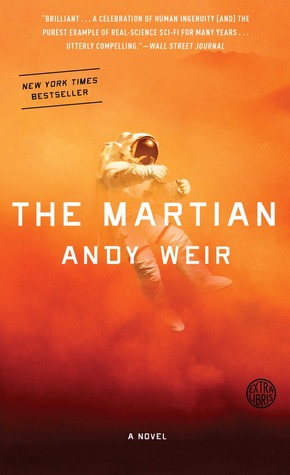
The Martian (Andy Weir, 2011)

Not to dogpile on the whole "2016 was the worst year ever", but 2016 was, in fact, the worst year ever (since I started keeping track) for reading. Other than losing two relatives, it was probably one of the worst parts of the entire year, so I'm glowing with determination to make 2017 great. Not, again, mind you. That was another part of 2016 best forgotten, but will probably be in our collective face for the next four years. I'll save the politics for the political blog, though.

The first post here for 2017 will celebrate the final book of a horrific reading year. Perhaps I was too ambitious in my reading selections in 2016, but this book was definitely not part of the problem. The Martian is a pretty smooth read all-in-all. The science and math glide by even the most hardened liberal arts major. Compared to the movie (which is very good) there are a lot more numbers tossed around, but it never got overwhelming. For the uninitiated, the flow of the book is survival against enormous odds, and every time it seems like all is solved, another, bigger problem gets in the way. It isn't original, but it makes for exciting reading, and it's a no-brainer that they'd make a movie out of it.

Way back when I used to read science fiction magazines. For a while it was interesting, but the magazine I read was really bent toward hard science fiction, a genre that is often guilty of sacrificing plot and characters for the sake of accurate science. Frequently they would publish stories that were very dull and/or simplistic in the hope that the science would blind readers to the limitations. By a certain point (and with the help of reading other magazines) I had checked out of it and moved on to other fields. As is evident here, I still read science fiction, but it tends to be the kind that doesn't wave science around to distract from a thoughtful story.

Given my background, The Martian seemed like a step backward. Granted, the characters are pretty flat in the book. Main character Mark Watney's narrative sounds exactly like the author in an interview. On the other hand, this is the author's life work and it took years to fall into place. The plot is still solid and the pacing of the action is all done very well. Overall it's the writing that probably got me into science fiction in the first place. It proudly shows the power of human ingenuity over adversity. Whereas, I started with Asimov and the other SF greats, this wouldn't be a bad place for younger readers to start. A word of caution: there is a lot of profanity in the book. For the most part it was used as an accelerant for the humor that infuses the book, but may be too much for some. If you're on the fence, read the first page. If that's too much, then maybe stick to the movie, which sanitizes it down comfortably to PG-13 levels.

While the copy I read was the same copy my wife bought and read a few months ago, this isn't a hard book to locate at any public library.

Wednesday, December 21, 2016

Tess of the D'Urbervilles (Thomas Hardy, 1891)

Once again, in the glow of completing another "classic", I must reflect back on my high school English curriculum. I went to a super-high-achieving public school, but I think all of the emphasis was on math and science. At least that would explain the disparity in my SAT scores. I don't remember a whole lot about my English classes. The last year I can recall doing grammar and vocabulary work was ninth grade, and the literature assigned was all over the map. I believe it was at the tender age of fourteen that Thomas Hardy's Tess of the D'Urbervilles was dropped in my lap with little context, so it is no wonder I hated it and ignored it (except for the movie) for the next 26 years.

What I really needed to appreciate it, assuming there was any hope for me at that age, was an historical and a literary context. We didn't learn a thing about the Victorian era in Britain or anything about the role of Wessex in the course of British history. Maybe they were expecting another class to field that one. Secondly, there should have been a more cohesive order to the selection of books to be read. For me, it wasn't until much later that I thought of putting authors like Austen, Dickens, and Hardy on a chronology. What trends were they establishing or working against? How did they approach the writing process?

With Tess 2.0, I had a better sense of these things, plus no problem reading the endnotes and supplements when I needed a little extra understanding. For this, I came out of the experience much better. Even though it was well over a hundred years ago, and in a foreign country, many of the themes of life's experiences shone through. Hardy was a bit of a rebel for being so frank about talking about the kind of things everyone knew was happening, but just didn't write about. Of course without this context, Hardy seems pretty darn prudish. So it's no wonder while so many students choose to revile the book. But all these years later, now I'm wondering if they have tours of the area. I guess that makes me a boring adult now.

On a housekeeping note, I'm tallying up my stats and it has been an embarrassingly bad reading year for me. I'm going to be mature and blame the marathon training, plus much of my reading energy being devoted to studying philosophy. There's a lot of good books on the horizon, so I'm looking forward to stepping up my game in 2017.

Friday, December 16, 2016

The Shining (Stephen King, 1977)

Partly because of marathon training and partly because I've been enrolled in another course this semester, the free reading (and by association this blog) has been on the light side. The post on The Shining can be found on my other blog project, Under the Tome. Go check it out!

Friday, November 18, 2016

What Is Ancient Philosophy? (Pierre Hadot, 1995)

Pierre Hadot's thesis is fairly simple. Ancient philosophy was not just a discourse, but a way of life. While the discourse aspect has stayed with philosophy, the way of life aspect has fallen away and only returns intermittently through history. One could say (as Hadot does) that Christianity, poised as another type of philosophy (a "revealed" one), absorbed the way of life part. This would in turn lead to some of the periodic estrangements between philosophy and religion.

This one was for class, but, as was the case with the other class, I'm glad for having read it. I'm a history person. Philosophy has always proved challenging for me to wrap my brain around. Even though the introduction was a bit daunting, I found the layout of the book to be straightforward and the direction was clear. It served well as our "textbook" for the first half of the course. In fact, I feel a little more lost with a secondary resource accompanying our further path into medieval philosophy. As for those primary resources, we covered them a little spottily, so I'll be going through and catching up on the missing bits and reporting back here soon.

Although I just called it a textbook, this is actually very accessible to readers of all interests, not just philosophy nuts. Therefore, it's a staple at most decent public libraries, not just academic ones, in spite of being published by Harvard University Press.

Friday, November 11, 2016

Driven to Distraction at Work (Edward M. Hallowell, 2014)

Maybe this is some kind of Harvard Business Review thing, but the e-book was published a couple months before the print version, so even though my book was published in 2015, the original publication date ends up being 2014. Details only a librarian could love!

Anyway, Driven to Distraction promises some big things, but, perhaps due to a serious oversell in the first chapter, I was left underwhelmed. In fact, I feel even more distracted than ever at work, but that probably isn't the direct fault of the book. Let's start with the book's problems. The structure of the book breaks distracted people down into six groups, with the sixth having confirmed Adult ADHD. As each (I presume) fictional/composite character is introduced, it is quickly shown that they have some kind of deep-seated family issues. So each vignette started off with me thinking "hey, I'm completely like that!" or "I know somebody just like that!" but then the backstory kicks in and broke those connections. Also, the folks portrayed all seemed very upper-crust and, even though they didn't say so directly, fairly white-washed. I could easily see this being a turn-off for more diverse readers. Also, the author is pretty strongly pro-medication. While I'm no anti-vaxxer nutjob (though I've been known to vote for them on rare occasion), it seems like drugs were the answer for Dr. Hallowell is almost all of the situations. The similarly-titled Driven to Distraction by the same author is a more general look at matter of Adult ADHD is many (not just work) aspects of life, so it's good to keep in mind he's coming from a more clinical rather than human resources perspective, which may be influencing his more open attitude toward medicating the problems.

On the other hand, it wasn't a totally useless reading experience. I think the matter of distraction at work is a very real thing. We can't just unplug the Internet, which is generally the beast in the room, even for the other types not called "screen suckers". Trust me, you do that and it just makes everyone slow and stupid. On the other hand the Age of Information has no filters and it's pretty easy to go from the programs you need to get your job done to TMZ, online games, and God knows what else. In the end I'll thank Dr. Hallowell for raising the issue, but I think much more work needs to be done and we need to think beyond pill popping to cope with the new reality.

Tuesday, October 18, 2016

The Restoration of Rome (Peter Heather, 2013)

I had no idea what a cut-up Peter Heather could be. The last time I read a book with such a wry tone, it was James O'Donnell's Ruin of the Roman Empire, which covered a part of the same time period this book did. Maybe there is just something inherently funny about the Ostrogothic kingdom? This book takes a more expansive view than O'Donnell's, not only considering Theoderic's kingdom, but also Justinian's Byzantine East Roman Empire, Charlemagne's "Holy" "Roman" "Empire", and the papacy as attempts to "restore" the Roman Empire.

Theoderic, being the most local, had the first stab at achieving this. Although we think of the Goths as hardcore barbarians (or kids who wear black clothes and heavy makeup) they weren't totally uncouth, and just as it wasn't built in a day, Rome (and the Romans) didn't wink out of existence in 476. Therefore, the Goths, particularly the Ostrogoths (or "eastern" Goths) who settled in Italy, absorbed a good deal of Roman culture simply by virtue of geography. O'Donnell, in particular, asserts that Theoderic had a good thing going (while Heather is less certain), until Justinian came out of the East and effectively squashed the Ostrogothic Kingdom in the sixth century. However, the Byzantines were spreading themselves awfully thin trying to tamp down the Vandals and Ostrogoths, leaving their eastern front vulnerable. Ultimately, as Heather puts it so well, Justinian's grand plans to restore the Roman Empire transformed the Byzantine Empire from a world power to a regional power, losing well over half its territory within a century of the initial Italian conquests. In the aftermath of these two failed attempts, the Franks, whose stock continued to rise, finally rose to the notion of playing the role of restorers. Unfortunately, the Franks' success probably wasn't destiny, but rather the good fortune of successive uncontested heirs, from Pippin through Louis the Pious. Unfortunately the return of big royal families and health children turned the whole project into a bit of a mess, rendering the Holy Roman Empire rather inert just a century after Charlemange's coronation. So what is left but the papacy, to be the heroic restorer of the Roman Empire?

Perhaps because I'm still fresh off a church history course, but I'm not sure I completely buy into Heather's claims that the papacy (by the 12th century) represented a restored Roman Empire. Sure, there were some good times, especially around the time of Innocent III, but let us not forget that in the time period following this book would include famous low points like the near-execution of Pope Boniface VIII at the hands of the king of France and the Avignon papacy that followed. This doesn't exactly scream Roman Empire except at perhaps its lowest points. So, perhaps Rome was "restored", but that moment didn't last. However, as the Ostrogoths, the Byzantines, and the Holy Roman Empire have all since faded away, while the papacy now maintains a global presence, perhaps it isn't entirely incorrect to speak of a restoration of a sort.

My copy of this book was a gift, and it was the British edition, no less. As Heather is British and it isn't written for children, I don't think the American edition is much more different than its cover. As it targets a general readership, the book is readily available at most public libraries, and since it does have a good measure of academic value, some college libraries have wisely acquired it as well.

Friday, September 23, 2016

Pope Francis: Life and Revolution (Elisabetta Piqué, 2014)

We're about three and a half years into the Pope Francis era and there is no shortage of literature on His Holiness. I recall back in March 2013 clearing off the Benedict XVI display, heavily laden with the voluminous Ratzinger bibliography, and replacing it with the single book I could find by the former Jorge Bergoglio, and trying to beef it up with whatever magazine covers I could track down. Nowadays the display is about as heavy as it was in 2012 and I don't even need the magazines anymore.

This particular book came out about two years ago, and it's already starting to show its age. When it was recommended to me, it was considerably more fresh, but have a gigantic prioritized reading list doesn't exactly help with keeping up with current events. So that's on me. However, the writing style, perhaps due to the author being a journalist, is a little crazy for narrating historical events. The chronology is quite jumpy, with the first half shifting between Francis's earlier career and the 2013 conclave. Furthermore, almost everything is told in present tense, which is a pet peeve of mine.

On the other hand, the author's credentials are impeccable (Argentinian and Italian - perfecto!). If you really want to dig into Pope Francis's first 18 months, you could do worse than this book. I will agree that it really capture's the character of Pope Francis and that an understanding of his pre-papal career makes his actions as Pope no surprise at all.

Perhaps due to the limited coverage of Francis's papacy and the somewhat minor publishing house (Loyola Press), this book may not be readily available from the nearest public library. It would make a good fit in a parish library (even a non-Catholic one), and I got my copy from my own library.

Monday, September 19, 2016

Happy Hour In Hell (Tad Williams, 2013)

Has it really been four years since I read the first book in the Bobby Dollar series, The Dirty Streets of Heaven? I really jumped on that one, but by the time I got around to the second, the whole series was finished.

The Bobby Dollar series is remarkable in a number of ways. First, it's not high fantasy like the awesome Memory Sorrow and Thorn books or the lackluster Shadowmarch series. And it isn't science fiction like Otherland. It's in that ill-defined genre probably best called "urban fantasy" where you find your Jim Butchers and Neil Gaimans. Second, the books (at least the first two) are not gigantic, each around 400 pages. Finally, from what I've seen, for the first time, Tad Williams managed to write a trilogy that stayed a trilogy! Sure, I've got the 1200+ page To Green Angel Tower, originally a concluding book 3, but now repackaged as a third and fourth book (Siege and Storm). Supposedly no paperback binding could hold it in one volume!

Last time I met the angel Doloriel (street name: Bobby Dollar), he was bouncing around the streets of the fictional San Judas. If you live anywhere between San Francisco and San Jose, you may be quick to notice that it is a parallel-universe conglomeration of pretty much everything between San Carlos and Mountain View, with Palo Alto, Los Altos, and Atherton being name-checked as "districts" and "downtown" is pretty much Redwood City. It was both cool (because I could relate), and distracting (because I kept trying to figure out if such-and-such bar was some place I actually knew). For about the first 100 pages or so, the San Judas action continues in this book. While, for the aforementioned reasons, I'm not too disappointed with San Judas, it felt like Tad Williams was punting a little in the world-building department, something he did very well (world building, not punting) in the Memory Sorrow and Thorn and Otherland books (Shadowmarch....let us not speak any more of this series). Well, things went straight to Hell right after that, and I mean that in the best possible way. Hell, which was the setting for almost the entire rest of the book, is a truly diabolical experience. Williams created a Hell that would make Hieronymus Bosch run for the exits and it has about a million more levels than Dante's Inferno. Even "high-class" Hell is horrific by Earth standards, and the lowest levels are beyond comprehension.

While Tad gets an A for world-building in this one, way improved over the first book, unfortunately it is a lot of fancy bunting for a meh love story. Maybe I'm not as passionate a person as Bobby Dollar, but it seemed like the whole trip to Hell, as wild a ride for the reader as it was, may not have been wholly necessary. I won't even tread near "the twist" -- and there is always one of those -- but once I was allowed to come back up for air in San Judas near the end of the novel, I had to suppress a shrug. You did all of that just to get that? Oh well, there is always book 3, Sleeping Late on Judgement Day. Be sure to look for my review of this final book of the series in 2019!

This book is pretty easy to find at public libraries. A lot of people I know are big on collecting (as in actually buying) the books, because they have pretty artwork, and you can meet the author and get them autographed, and so forth, but I kind of felt burned by Shadowmarch and demoted Tad to library-only and so far I've been fine with the decision. If you mostly know Tad from his other series, be advised that this one likes to toss in more robust sex and language in addition to the violence, so I would think before buying these as presents for your under-15 family member, especially if they've never watched an R-rated movie.

Wednesday, September 14, 2016

Slaughterhouse-Five (Kurt Vonnegut, 1969)

Slaughterhouse-Five neatly falls into the Venn diagram middle of "books that are classics" and "books I genuinely want to read"...and maybe throw in another circle of "books I really should have read in high school."

I discovered Vonnegut through the science fiction path. His early works up through Cat's Cradle easily qualify, putting him alongside unlikely folks like John Updike (and Jonathan Lethem I suppose) as authors who committed acts of science fiction in their career that are not regarded as science fiction authors. Before now I've read the aforementioned Cat's Cradle, Player Piano, and the perhaps not-so-SF God Bless You, Mr. Rosewater. More importantly, I also have read the story collection Welcome to the Monkey House, which holds a tone closest to this book, and also includes the important libertarian-SF classic "Harrison Bergeron".

If anything this may be a step back toward SF from God Bless, although if you want scientific explanations for things like time travel, you will be disappointed. It's just a fact here that Billy Pilgrim jumps randomly through time, everywhere from his childhood to his deathbed, and, critically, his war experience, which includes the fire-bombing of Dresden.

The book owes a fair bit to its predecessors, with characters like Kilgore Trout and Eliot Rosewater making appearances. Also, in an almost Michener-esque way, the book doesn't even begin properly until the second chapter, as the first is devoted the conception of the novel by Vonnegut's alter ego...his non-Trout one, to be clear.

Finally, I'm not one for trigger-warnings, but if you are unable to process a horrorific scene of animal cruelty, you may wish to proceed with caution with this book. Make no mistake, the reward of reading a classic outweighs this single scene, but it remains burned into my mind's eye and still makes me shudder to imagine. Also, it was around this time that books other than Catcher in the Rye could use salty language (and quite frequently), so bear this is mind as well if you were thinking of suggesting this for younger readers. Any mature adult shouldn't have a problem with this, though.

I picked up a mangled old copy of this book from the public library that, while probably isn't a first edition, has pretty much the same layout and pagination. Since this is a pretty regularly assigned required reading book (accepting the aforementioned caution), it isn't hard to locate paperback copies on the cheap.

Friday, September 9, 2016

'Salem's Lot (Stephen King, 1975)

This is a repost from Under the Tome, my insane noble Stephen King reading project. Please feel free to follow along and I work my way from Carrie to End of Watch (or whatever the last thing King has published when I get there).

Over the past two weeks I heartily enjoyed sinking my teeth into Stephen King's second novel, 'Salem's Lot. Unlike Carrie, the subject matter cuts much closer to King's interests as a developing writer. While the first book pivoted between publication and the circular file before finally leaning to the former, this book had been brewing for quite some time.

This book is about vampires. I'm not sure if that was supposed to be a huge surprise for the first readers. On the other hand I have the advantage of forty years of hindsight, as the book (and most of King's early books) is firmly entrenched in the zeitgeist of American fiction, so it is hard to escape the easy labeling of the book as his "vampire novel". Also, this is the first book that feeds into the Stephen King Megaverse, anchored by the Dark Tower series, so it's a generally-known fact through this connection that there is going to be a supernatural angle.

That is something I've had to get used to with this project. Stephen King isn't (primarily) a mystery author, he does horror and suspense. This means there isn't a reason for the destruction of Jerusalem's Lot that is grounded in reality. It's the same kind of adjustment that needs to be made if watching a later episode of Scooby-Doo and learning that the monster is not just some crank wearing a mask, but a real monster. This makes the more obvious explanation ("Barlow is a vampire") the correct one, rather than something surprising ("Barlow really is just a kindly antiques vendor and somebody innocent-looking is actually infecting the town with flu because he's mad about something"). The fun, therefore is not in the discovery of the truth, but in what the protagonists plan to do about it, and if they will survive.

Given where I work, I found the religious aspects of the novel to be interesting. Although I mentioned a little bit of flawed theology in the "progress report" post, I was surprised by how much religion played into the battle against the vampires. Father Callahan is a tortured guy, living in the decade immediately following Vatican II and clearly struggling to accept the modernization of Catholicism. Yet he has more than enough personal demons to battle, all of which fall in line when confronted by the vampire threat. More than any classic vampire weapons, crosses and holy water were the most fundamental and effective tools against Barlow, so much so they even glowed with power (bestowed on them through prayer and absolution, no less). There is also considerable discussion about faith among the characters, as well as the differences of spiritual experience among the denominations present in the town (Catholic, Lutheran, Mormon, and maybe another I'm missing).

As I was reading I thought of some of the other famous works of vampire fiction and how much (or little) they owe to each other. In his 1999 introduction to 'Salem's Lot, included in my version, King credits Bram Stoker's Dracula as an early inspiration, it did not serve as the template. Rather, his vampires come from the comic book type, the ones that are a lot nastier and commonplace than the one-off Count Dracula. The weapons and weaknesses are fairly standard: wooden stakes, crosses and holy water (definitely), sunlight, silver (maybe), and garlic (not really, more of an allergic reaction). Vampire victims typically become vampires themselves, but more zombie-like with only limited cunning and confined to the town. Unlike Stoker's world, they are not charming, except if you are dumb enough to stare into their eyes. I had to remind myself that Anne Rice only jumped into the genre the following year, so if anything, she owes King, not the other way around, for any similarities. More likely, though, they were both drawing from the same inspiration and also trying to differentiate from Stoker. Although Barlow alludes to being far older than the Church, King doesn't delve into "vampires spanning time" the way that Rice does. Her vampires are also better looking, if you take the movie into account anyway. About 25 years later, Charlaine Harris would get in on the act with the Sookie Stackhouse/Southern Vampire series, and when her novels were adapted by HBO as True Blood, it seemed like another wave of vampire mania was upon us. Harris plays far more off of Rice's innovations (sexy vampires spanning time), and both are guilty of cranking out endless books in their respective series, both of diminishing quality.

Stephen King, unlike Anne Rice and Charlaine Harris, never wrote a proper sequel to 'Salem's Lot, although some plot elements would be worked into his later novels. Though not actually novels, this book has a prequel ("Jerusalem's Lot") and a sequel ("One For the Road") which were both published in King's first story collection, Night Shift. More about those when I get there!

'Salem's Lot has never enjoyed a theatrical release, but it has had two two-part miniseries adaptations, from 1979 and 2004. This probably has something to do with the "slow boil" plot that, if rushed into a 100-minute format, would make the climax all the weaker. However, this didn't stop an ill-advised sequel, A Return to 'Salem's Lot, from reaching the big screen in limited release in 1987. Just like with The Rage: Carrie 2, I think I've got more important things to watch!
Tuesday, September 6, 2016

Built to Last (James C. Collins & Jerry I. Porras, 1994)

For those not familiar with the towering epics of business literature by Jim Collins, here's a quick overview. Built to Last came out in 1994 and made a moderate splash. In 2001, he wrote a sequel of sorts called Good to Great, which completely overshadowed its counterpart, so much so that even the author himself suggests reading the "sequel" first. Although the definitions and methodology are all around in Built to Last, he articulates the distinction between the "great" companies (the profiled ones) and the merely "good" ones (the comparison companies) in Good to Great.

Part of the popularity (or detraction) of the book is the anecdotal format. Methodology is largely held to the front matter and the appendix. It is solid methodology, very scientific and quantitative, but the meat of the book is the stories about the different companies, both the enduring companies and their comparisons. It is interesting to read about how Philip Morris started as a London smoke shop, and Marriott was a root beer cart at its beginning. Although the book firmly disavows CEO personality as a factor in the endurance of a company, there is a lot of wisdom spooned out from the leaders of these companies. I recall when reading this interrupting my wife from whatever she was reading to say "did you know...?" about some company and/or its leaders and founders.

Where the detractors may get some credit is that the anecdotes, while fun to read, sort of mar the practical aspects of the book. I can't really think of the anything I read in the book that made me think "a-ha! I will use this at work!". Perhaps the very notion of the enduring company is hard to "implement", even though the authors stress that one need not own a company, let alone a famous one, to learn from the book. So, if anything, I walked away from this book learning more about these companies from their birth to the present day and those factoids are now in my toolbox and may prove useful at unexpected times in the future.

My copy (cover pictured here) was the old hardcover edition, so there was no whisper of Good to Great here. I think later editions, only mildly different, may suggest practical connections for readers between the two books.

Friday, August 26, 2016

Hadrian and the Triumph of Rome (Anthony Everitt, 2009)

It's conventional wisdom to think that the further along through history we go, the more we know about the times. Alas, not quite true. The case in point here is the third in the Everitt trio (Cicero, Augustus, Hadrian), for which the information available is the scantiest. This results in quite a bit of speculation of Everitt's part about why Hadrian or one of his contemporaries would do what they did.

Otherwise, this book does a real service of giving Hadrian his first proper biography since the early/mid 20th century. It is actually surprising he hasn't gotten more attention, giving the particular fascination in Britain, perhaps due to a certain wall up north. Also, in general, Hadrian is consider one of the "good" emperors, meaning he wasn't overtly crazy or cruel. He was born and raised firmly in imperial times, so he had no sense of life under the old Roman Republic, but he learned early in his reign to temper so of the more megalomaniacal impulses. Therefore, following his adopted father's expansionist impulses, Hadrian was an emperor of limits and restraint, a new thing for a Rome that previous knew no limits.

Hadrian was also a Lincoln type figure in that he inspired many of his successors to sport beards. In Hadrian's case, it may have been just as much to cover up spots as to honor Greek culture.

Finally, Everitt doesn't make Hadrian out to be angelic. His obsession with the young Antinous was so over-the-top as to just be weird, even for those who understand and accept that homosexuality in the ancient world was treated differently than in modern times. Also, his treatment of the Jews and Jerusalem was downright barbaric and quite possibly the inspiration for all acts of ethnic cleansing for the rest of time. Therefore it is hard for me to unreservedly call Hadrian "good", but I suppose compared to what lay behind (Nero, Caligula) and what lay ahead (Commodus and just about everyone after that), Rome had done and would do far worse.

Although I found my copy here where I work, this book is easy to find at most public libraries, as it targets a general readership.

Friday, August 19, 2016

Personal Writings (St. Ignatius of Loyola, 1522-1556)

Much like Journal of a Soul, the completion of this book was a "mop-up" operation. For class, most of our attention was on the short biographical sketch, spiritual diary (lots of crying at Mass), and the Spiritual Exercises. The forty or so letters that make up the bulk of the middle of this book, assembled in 1996 for Penguin Classics, were left for individual study and a paper. Therefore, during class I focused heavily on the seventh letter (more on that below) and heard the thoughts of the other students on a few of the other letters. It was interesting to go back, with one finger on the timeline of St. Ignatius's life, and read through the letters and reconstruct early Jesuit history, so I'm glad I spent the time doing so.

My "focus letter" was the seventh ("Blueprint for a New Order") in which Ignatius criticizes some of the failings of the new Theatine order, founded by future antagonist Pope Paul IV, to whom the letter is addressed. You can see Ignatius resolving not to follow the same path with the Jesuits, although their reforming goals are quite similar. Although there were many other insightful letters to choose from, I'm glad I picked this one.

As far as a reading this book cover to cover, it was a little challenging in spots. The quasi-contemporary biographical essay was fairly interesting, but the "spiritual diary" was a little strange, with Ignatius usually recording whether or not he cried at Mass and not a whole not more. The letters need to be read with some space in between each one, otherwise it ends up being a blur and not doing justice to each individual work. The final section, the Spiritual Exercises, are no doubt historically important, but at times feel like reading an instruction manual. I mean, it sort of is an instruction manual, and a very important one at that for the historical record, but it can be easy to glaze over the finer points if speed reading and trying to meet deadlines!

Wednesday, August 3, 2016

The Christian Tradition 2: The Spirit of Eastern Christendom 600-1700 (Jaroslav Pelikan, 1974)

Either I'm getting better at reading theological works, or Pelikan threw me a softball on this one. I'm hoping it is more of the former, but trying to cover 1100 years of history in one volume in roughly the same number of words as his masterful first volume (which covered "only" 500 years) would be a challenge for anyone, even a super-genius like Pelikan.

For a lot of us Western Christians (Catholics and Protestants alike), the Eastern Orthodox churches are mystical and mysterious. There is certainly elements of that, particularly later in the book when mysticism really took off. But Christianity in the East was primarily about arguing over the exact nature of Christ, the Trinity, the Holy Spirit, etc. using the expansive and excruciatingly detailed Greek language to make the distinctions those crude Latin-based tongues in the West were so woefully inadequate at doing. Never mind repeated invasions and the eventual destruction of the primary political vessel of Orthodoxy (the posthumously-named Byzantine Empire) during this time from both (further) East and West.

Pelikan spends a good deal of time discussing the Nestorians and Jacobite/Monophysite churches, heretical but enduring sects of Christianity with their own theological and philosophical constructs. Thanks to his even-handed treatment, one can understand why these churches were moderately successful, hanging out at the fringes of empire (and ultimately the first absorbed by a nascent Islam). That's not an easy task, considering almost all we know about these groups comes from their enemies' citations of their own work to be used against them.

Ultimately, the Slavs and Russians are poised at the end of this volume to inherit the theological mantle of the Byzantines. They don't get a whole lot of exposure in this book, even though the last 250 years of the coverage period are post-Byzantine, but Pelikan promises us a return to the East in the fifth and final volume of the series, something I'll probably tackle in 2017!

Thursday, July 28, 2016

Journal of a Soul (Pope St. John XXIII, 1964)

I'm wrapping up some loose ends from my recently completed Church History course. Only selections from this book were read in class, so I read through the remaining gaps last month.

If you don't know anything about Pope John XXIII, a straight biography may be in order before reading this. However, the documents presented here (mostly journal entries from retreats, plus some letters and short published pieces) will certainly get readers into the mind of the Pope, who was 80 years old when elected and not expected to do much more than get from Pius XII to whoever would succeed him. Reading even the earliest entries, it is no surprise that he would instead take on an ambitious agenda, crowned by the convening of the Second Vatican Council. Also remarkable was that this book was the first book of a pope's personal writings published with the active consent and support of the author.

Fans of Pope Francis will likely find Pope John to be an early inspiration. It isn't surprising that the book is available across academic and public libraries, though not necessarily every single one. If you are Catholic (or pointy-high Episcopalian!), the easiest thing to do may be to consult your parish library, if you have one. Editions vary (mine was from 1999), but they should all read the same, more or less.

Wednesday, July 20, 2016

Year Zero (Rob Reid, 2012)

I needed this book. It wasn't the greatest book I've ever read, let's be clear about that, but in a reading list where the science fiction has to share an increasingly crowded stage, and a general lack of humor through most of the titles, this was welcome.

The premise of Year Zero is completely ridiculous. It turns out that humans, while woefully under-civilized among the myriad races of the galaxy, do one thing really well, and that is make music. Unfortunately, they also have the most expensive legal system of copyright, resulting in a galactic bill in royalties, permission, and (mostly) fines totaling in excess of a dollar figure higher than all of the economies of the galaxy combined over the entire course of history. Needless to say, the more sinister elements of the galaxy have decided that if Earth were to mysteriously explode, then the whole matter would fix itself.

Enter the hero, music copyright lawyer Nick Carter (no relation to the singer or the Carter name in the firm he works for). Through some horrible mistake related to the parenthetical phrase in the previous sentence, ridiculously-dressed alien visitors with weird names approach him to figure out a solution to this colossal problem. Along the way, we learn about the infectious nature of reality television, and why Windows was a necessary invention to keep humanity in its place in the galactic order. You will also get an ample dose of Reid's thoughts of various types of popular music, much of which I found myself agreeing with, although I still haven't come around on Simply Red.

Leave any and all disbelief at the door with this one, or you will just be frustrated. This is primarily a work of satire targeting the music industry, which Reid (as one on the inside of the industry) does very well. If you are hoping for scientifically accurate depictions of alien culture, look elsewhere. This is more Douglas Adams than Arthur C. Clarke.

According to Worldcat, the book is fairly common at libraries, but as far as being a core title it is probably still too new to tell. I wouldn't be surprised if the e-book over time becomes a more common way of reading this title. Incidentally, the Korean translation popped up second in my search, which, if you read the book, you will find strangely appropriate, although the language gags may fall flat. Do not confuse this book with Year One, a nonfiction book about Harvard Business School by the same author.

Friday, July 15, 2016

A Passage To India (E. M. Forster, 1924)

To begin in an indirect way, I watched the first series of Indian Summers on PBS last fall. It was clear that Channel Four (and PBS) were hot to push it as a Downton Abbey successor and it felt pretty exciting to get in on the ground floor of the next big thing, even if it wasn't quite as good. Well, I can toss all that out since I just read it was canceled after the airing of the second series in the UK, so who knows if I'll see any more of it. Even if it ended up being a truncated epic, it made me realize just how little I knew about British India.

Therefore, the timing of A Passage to India wasn't bad. While I still lack a basic textbook knowledge of the period, at least I came in with a general sense of the look and feel of the times, which are nearly the same as the TV show counterpart. Of course, the plots are not at all the time, plus the writers of the TV show had the gift of hindsight. I had to keep this in mind when reading that Forster, who, in 1924, did not have a crystal ball or ESP.

Forster has a pretty keen sense of the fractures among the Indian people, between Hindu and Muslim, and well as the tension between English and Indian. He is not shamelessly for one side or the other, and I was changing my mind throughout the book as to who the "good guys" were in the book. I suppose Mrs. Moore could be seen as the most sympathetic, but her character was also quite passive as well as absent from about the halfway point onward. Dr. Aziz was the most convoluted character, a generally good man, but with a lot of dark thoughts and horribly framed for a crime he clearly didn't commit. Mr. Fielding is nice enough, but comes off as rather hapless. Then of course there are the definitely-bad English (Turton, Callendar) and definitely-bad Indians (Lal). Needless to say it's a complicated book.

Admittedly the first half was pretty dull, focused mainly on character development. However, that early focus paid off in the second half, following the Crime in the Caves, and thrusting the reader into an Anglo-Indian version of To Kill a Mockingbird. While there aren't any great big car chase sequences, there's enough tension to keep things moving along at a surprising clip during the novel's second half.

As you can see by the beat up old-timey cover above, I read a very old hardcover library version of the book. Since it is still required reading in many schools, probably at the more advanced levels of high school, you shouldn't have any problem finding a copy at the public library. However, if a banged-up threadbare book would embarrass your nightstand, a sparkly new paperback copy is easy enough to find, either at Amazon or a regular bricks-and-mortar bookstore.

Tuesday, June 28, 2016

Bernd and Hilla Becher: Life and Work (Susanne Lange, 2006)

Years ago I would leaf through Choice cards for ideas of what books to buy for my library. It was an old-timey library as you might have guessed from seeing me use the term "Choice cards". Anyway, that's what I did at the reference desk between helping patrons until my boss thought I was secretly undermining her authority and asked me to leave, but that's another story (but I will say that she quit the library world altogether a few years back, and there was much rejoicing - may she never return!). Ahem, so these cards guided what books would be good for the library, but I kept notes on books that seemed interesting to me, but would serve no good purpose for the library. These would be tracked down later and enjoyed on my own time. Time passed and the selections worked their way up my reading queue, and the next thing you know I needed to find a copy of Bernd and Hilla Becher: Life and Work...stat! Thankfully it was the Berkeley Public Library to the rescue, but this title, in the few places it is held, more often than not does not circulate.

Now what in the world possessed me to want to read this book? Needless to say, art/photography titles are pretty rare on my to-read list. I think the last one was Art For All, a collection of posters and essays about the London Underground. As for this book specifically, I think it's because I've had a weird relationship with industrial architecture. I remember being terrified of big factories as a kid. I have no idea why. Maybe they seemed dirty, or perhaps they made me feel insignificant. It didn't help that I had books like The Lorax and The Wump World telling me they were destroying our environment (and yet automobiles did not have this effect?). So perhaps it was a "fear your fears" moment, to sit down with a book filled with images of blast furnaces, gasometers, and other beastly contraptions. I didn't know a thing about the Bechers, so the essays were insightful, though complicated, as to what motivated one to take pictures of buildings most people find ugly. It turns out that if nothing else, I felt kind of sad about these buildings. Many of them no longer exist, and in some cases they were demolished immediate after (or even before!) the Bechers went to document them. The buildings are considered "anonymous architecture", meaning nobody really seemed to know or care who designed or built them. In fact, many people, especially in the United States, had no idea why the Bechers would want to take pictures of these god-awful things, and were more invested in keeping an eye of them like they were masters of industrial espionage.

All in all, the book was fine. However, if you just want to look at pictures of water towers and mine shafts, you may not find the essays all that interesting. While I'm glad I spent the time learning about two German photographers and their methodology, it is relatively academic-slanted writing which at times may only make sense to hardcore photographers. A lot of it deals with old-school film-based photography, so I would be curious about what the Bechers thought of digital photography, which has all but rebuilt the landscape of professional photography. While both were probably aware of these changes (Bernd died in 2007 and Hilla in 2015), you won't learn anything about that here.

Here's a pro-tip for locating a hard-to-find book: Unleash the power of interlibrary loan! Many public libraries will acquire out-of-print and hard-to-find books for you to borrow, typically for free or just a small fee to cover shipping. If you are not fixated on ownership, this is a great way to read deeper into authors and subjects. Keep in mind if you are prone to returning books late or losing them, the fees for your misbehavior can be staggering, but otherwise, give it a shot! As was my case, many California libraries use Link Plus to handle these loans, and it worked like a champ for me both times. If it's not available through Link Plus, I usually exploit my own library's interlibrary loan system, but that is fairly rare (and generally the privilege of being a librarian!).

Friday, June 24, 2016

Carrie (Stephen King, 1974)

This is a repost from Under the Tome, my insane noble Stephen King reading project. Please feel free to follow along and I work my way from Carrie to End of Watch (or whatever the last thing King has published when I get there).


Appropriately enough I finished the first book of this insane project just a few minutes before midnight.

The moral of Carrie is that should not be a bully because you can never be sure if the kid you're picking on has insane telekinetic powers capable of killing you, most of your friends, and burning your school to the ground. And effectively sucking the life from your hometown. In Maine. Although it's a relatively short book, it demonstrates Stephen King pouring on the fear factor right out the gates. Although King would explore other genres of popular fiction, his success with Carrie established horror as his wheelhouse, the genre he would quickly become the "master" of within a few years.

First books (and albums, too, but not so much movies) can be tricky. Often a lot of work to "get noticed", not to mention the inevitable rejects that came before, impact the delivery of a debut work. This results in the debut being substantially different than the rest of the author's oeuvre. Especially in music this can end up being a disastrous trap where no future album can ever live up to the debut, usually resulting in a very short lifespan for the band or artist's career. In other cases, usually more common with books, the debut is strong but uncharacteristic of anything else the author will write. The second book may be weaker, but it establishes the tone for most or all future works. In this particular case I think of popular mystery authors who usually write in series, like Michael Connelly, Robert Crais, and so forth.

To apply this to Stephen King is a little dicey in that this is not the first book in the adventures of Carrie White. I don't think anybody finished the book thinking "when's the sequel coming out?" On the other hand, from the little I know that lies ahead, I'm pretty sure King wasn't planning on using the structure or tone of Carrie in his future books. Carrie had a unique challenge in that King had no fan base or name recognition at this point in his career. If he had written a lame book, assuming it even made it past the publisher, this probably would have been it for his writing career. Thankfully, this was not the case, and the book opened the door for King to go more in-depth. Just for comparison, 'Salem's Lot is twice the length, and It is something like five times longer.

The book isn't perfect. In most lists attempting to rank all of Stephen King's books it usually lands in the upper part of the middle, and rarely/never makes a top 10 or 20 list. The length makes the book feel a bit lightweight, but again this goes back to "first book" issues. A lot of publishers aren't going to clear cut a forest to produce a book written by an unknown. Also, toward the end the suspension of disbelief gets harder to maintain. People somehow seem to just "know" about Carrie, even those that have never met her before. It feels like a punt, but who knows what the reasons were for some of the shortcuts. We'll explore this further with the screen adaptations yet to come, but the inclusion of fake book segments and articles may not be to everybody's taste. I thought it was particularly interesting that King would effectively insert spoilers into these bits. Anyone genuinely shocked by Carrie's rampage at the prom obviously did not read these.

Overall, I was pleased with the book and I can see why a movie would be released so quickly as well as understand how this essentially made the rest of Stephen King's career possible. I am looking forward to reading the novels ahead, many of which, unlike this one, rank very highly with the diehard fans.

Thursday, June 23, 2016

Work Rules! (Laszlo Bock, 2015)

It was more than a little surreal to read a book called Work Rules! at the same time as "Leisure the Basis of Culture" by Josef Pieper. Needless to say, these guys don't roll in the same circles, never mind the fact one died just before the professional life of the other began. It was hard not to see these books as opposed to one another, but with a little discipline I was able to put each one in its place. Nevertheless, the two books have such wildly different assumptions of what constitutes a culture that they are never going to dovetail.

Whereas Pieper fears the culture of "total work", Bock lives it. He isn't writing a book about work/life balance, so it's not as if the message of the book is to "shut up and work", but rather to make your work enjoyable, which is assumed by Bock (and most members of Western culture) to define ourselves and give us meaning. Pieper would disagree here, but I'm going to have to set my favorite German philosopher aside at this point and examine Bock's work directly.

In case it isn't clear from the subtitle, Laszlo Bock is a Google guy. Google fascinates just about everyone, so it is only natural that a book about Google's "people operations" (don't you dare say "human resources", you cro magnon) is going to garner a lot of interest. While the cover and title are radiant and designed to attract from the bookshelf, I discovered the book through a reference from How Google Works, which was citing this book a year before its publication. Each chapter discusses different aspects of working environments, with ample examples of how Google does it. Then you get a set of "rules" at the end of the chapter that summarize the key points. The tone is encouraging, but it can also be overwhelming. For example, I'm just a middle manager type in a very small division of a small operation. I can't do what Google does. To his credit, Bock acknowledges that most readers aren't going to have the same resources, but he scales his suggestions to fit a variety of settings.

Finally, read all the footnotes. Oddly enough, the thing about this book that stuck with me the most was a pancake recipe in the footnotes. I can't resist a good stack of flapjacks, so I intend to try it soon. There are also endnotes, but most of these are just references, so you aren't depriving yourself of the full Google experience if you skip them.